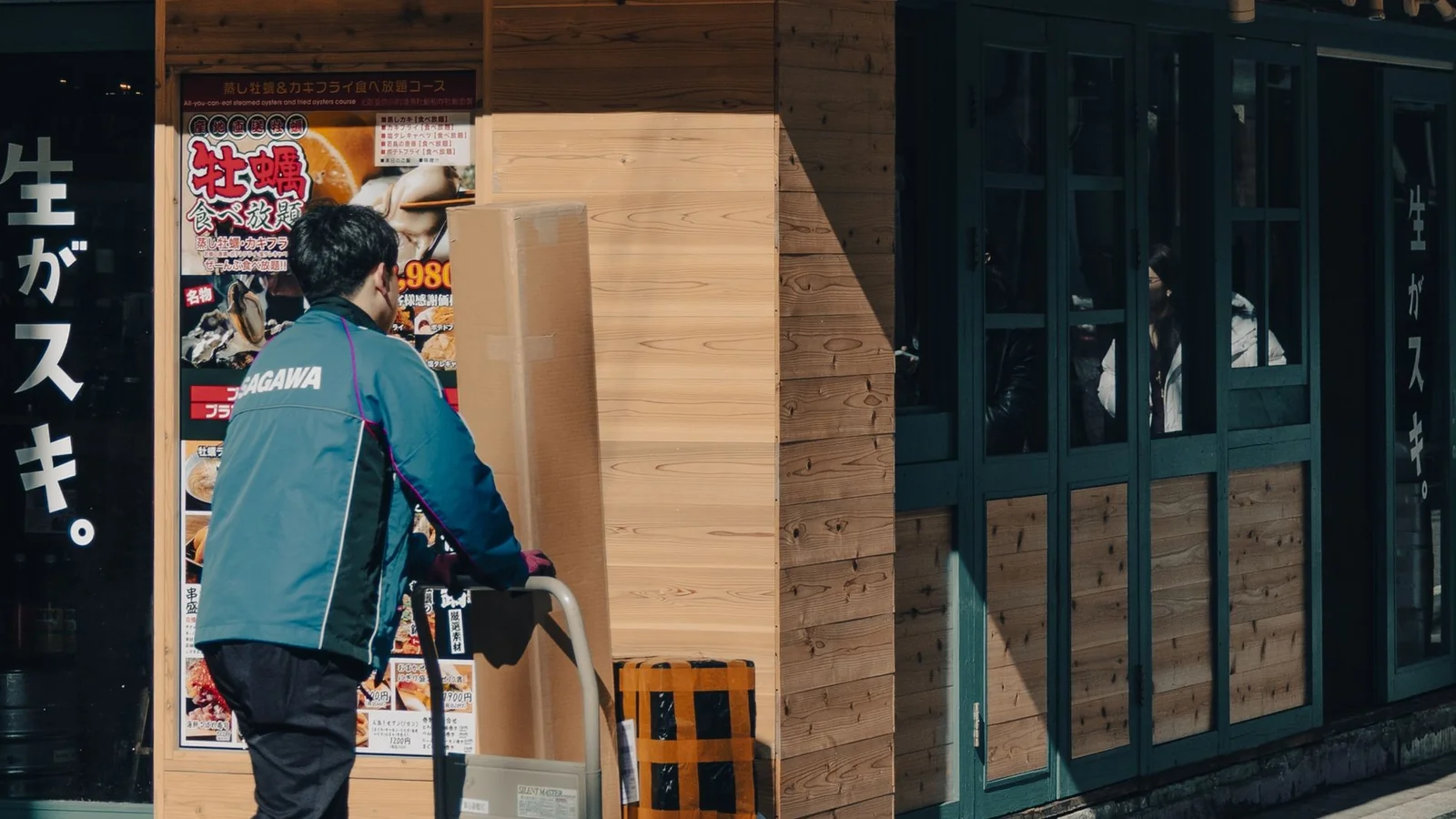
Forwarding a suitcase can make a multi-city Japan trip easier. It can also send your clothes to a hotel you have already left.
The useful starting point is not “How much does luggage delivery cost?” It is “On which night will I next need this bag, and who will receive it?” Match the bag's itinerary to your hotel bookings before comparing delivery with carrying it on a train.
Choose the job first
| Your actual problem | First option to investigate | Check before committing |
|---|---|---|
| You need the bag at tonight's hotel | Carry it, or confirm a specific same-day delivery service | Cut-off, destination coverage and arrival arrangement |
| You want to skip one or more short hotel stops | Forward to a later, staffed accommodation | Its acceptance policy and the carrier's delivery date |
| You are returning to the same place later | Storage | Collection hours, allowed duration and bag size |
| You are heading straight to a flight | Carry it, or arrange a verified airport-delivery service in advance | Correct airport, terminal, counter and deadline |
Storage does not move the bag to your next city. Forwarding does not make an unstaffed apartment able to receive it. Same-day delivery is a particular service, not a default promise.
Do not build the plan around “next day everywhere”
Yamato's accommodation FAQ asks customers to dispatch before the relevant cut-off at least two days before check-in, with three days potentially needed depending on distance. It also requires the accommodation to accept the parcel. That FAQ is conservative accommodation guidance, not a live delivery quotation for every hotel-to-hotel route. (Yamato hotel delivery FAQ)
Yamato separately offers same-day delivery on limited routes from selected counters, with location-specific deadlines and possible delays. (Yamato same-day delivery coverage)
Ask for the delivery date for your exact origin, destination, handover time and service. “Usually next day” in a general guide is not enough when you stay only one night.
Write the agreed delivery date beside the recipient hotel's check-in and check-out dates. If there is little room between them, send to a later stop or keep the bag.
Give the suitcase its own itinerary
Consider this invented itinerary:
| Night | Traveller's accommodation | Possible suitcase plan |
|---|---|---|
| Monday | Tokyo hotel | Arrange dispatch if the receiving hotel and carrier confirm the timing |
| Tuesday | One-night ryokan stay | Travel with a smaller bag |
| Wednesday–Friday | Kyoto hotel | Receive the suitcase here on the confirmed date |
This is a planning example, not a promise that Monday dispatch will reach Kyoto on Wednesday. It works only if the sending arrangement, delivery estimate and receiving hotel's policy all align.
Now test an alternative: Tokyo on Monday, Kyoto on Tuesday, Osaka on Wednesday. Sending the suitcase to the one-night Kyoto stop creates more timing risk. Forwarding to the longer Osaka stay may be more practical, provided you can carry everything needed until the confirmed delivery.
The objective is fewer handovers, not forwarding a bag at every checkout.
Confirm both ends before handing it over
Send the receiving accommodation a short request containing:
- Your reservation name and booking reference.
- Check-in and check-out dates.
- Expected bag count.
- Carrier and expected delivery date.
- A question about how early it will accept the bag, any storage charge and where you collect it.
For the sending end, ask whether staff can arrange the shipment, which cut-off applies and how payment works. Yamato's accommodation FAQ says delivery to guest accommodation cannot use its cash-on-delivery arrangement; do not assume the receiving desk will pay for you. (Yamato hotel delivery FAQ)
Use the receiving hotel's full address and phone number as supplied by that hotel. Branch names matter: a chain can have several properties in the same city.
With an apartment, vacation rental or unstaffed guesthouse, obtain explicit receiving instructions. If nobody can accept the delivery, ask the carrier about an eligible collection location rather than improvising an address.
If you carry the bag, measure it before booking the train
For the Tokaido, Sanyo, Kyushu and Nishi Kyushu Shinkansen, JR West describes special arrangements for ordinary luggage whose three dimensions total more than 160 cm and up to 250 cm. Oversized luggage needs the appropriate reserved seat/baggage area. Bags over 250 cm are not permitted under the cited baggage rules; weight and item-count limits also apply. (JR West oversized luggage guide)
Measure height + width + depth using the bag's actual external dimensions. Do not use an airline's “large suitcase” label as a rail classification.
There is a particularly easy source of confusion. A Smart EX notice describes a trial, beginning 1 July 2025, allowing use of certain deck storage spaces without reservation on 16-car Tokaido/Sanyo trains. The same notice still requires a seat with an oversized baggage area for bags over 160 cm and up to 250 cm. It does not remove the oversized-baggage requirement. (Smart EX baggage-storage trial)
Check the current notice and your actual train when booking. These named-line rules are not a statement that every train in Japan has the same storage system. Our Japan train-ticket guide explains the separate ticket and pass decision.
Pack for the confirmed gap, plus a delay
Keep a smaller bag with everything you cannot comfortably do without until the suitcase arrives: travel documents, payment methods, essential medication, chargers, a clothing change and items needed for your next activity.
Ask the carrier about prohibited items and valuables before packing. Do not treat a normal suitcase delivery as an appropriate service for every object.
Save the shipping receipt and tracking number. Before leaving the sending location, check the destination, recipient name and delivery arrangement on the receipt.
If tracking suggests a delay, contact the carrier and the receiving hotel promptly. Changing hotels while a parcel is in transit should be discussed with the carrier; do not assume a booking cancellation automatically reroutes it.
Compare the whole cost
Obtain the carrier's actual quote for the bag and route. Then compare it with the costs and friction of carrying it:
| Forwarding | Carrying or storing |
|---|---|
| Delivery charge and any recipient storage charge | Storage fees where required |
| Transport to a drop-off point if needed | Any larger vehicle needed for luggage |
| Essentials needed while separated from the bag | Station access, lifting and transfers |
| Consequences if delivery is delayed | Consequences if suitable storage or baggage seats are unavailable |
Not every benefit needs a yen figure. Keeping a bag with you may be worth the effort when plans are fluid. Sending it ahead may be worth paying for when a family would otherwise manage several bags through short stays and transfers.
For the final airport journey, ask about airport delivery specifically. Do not extrapolate hotel delivery deadlines to a departure counter. Record the flight date, terminal, collection point and collection hours before paying.